Bookkeeping vs. Accounting: What Does Your Business Actually Need?
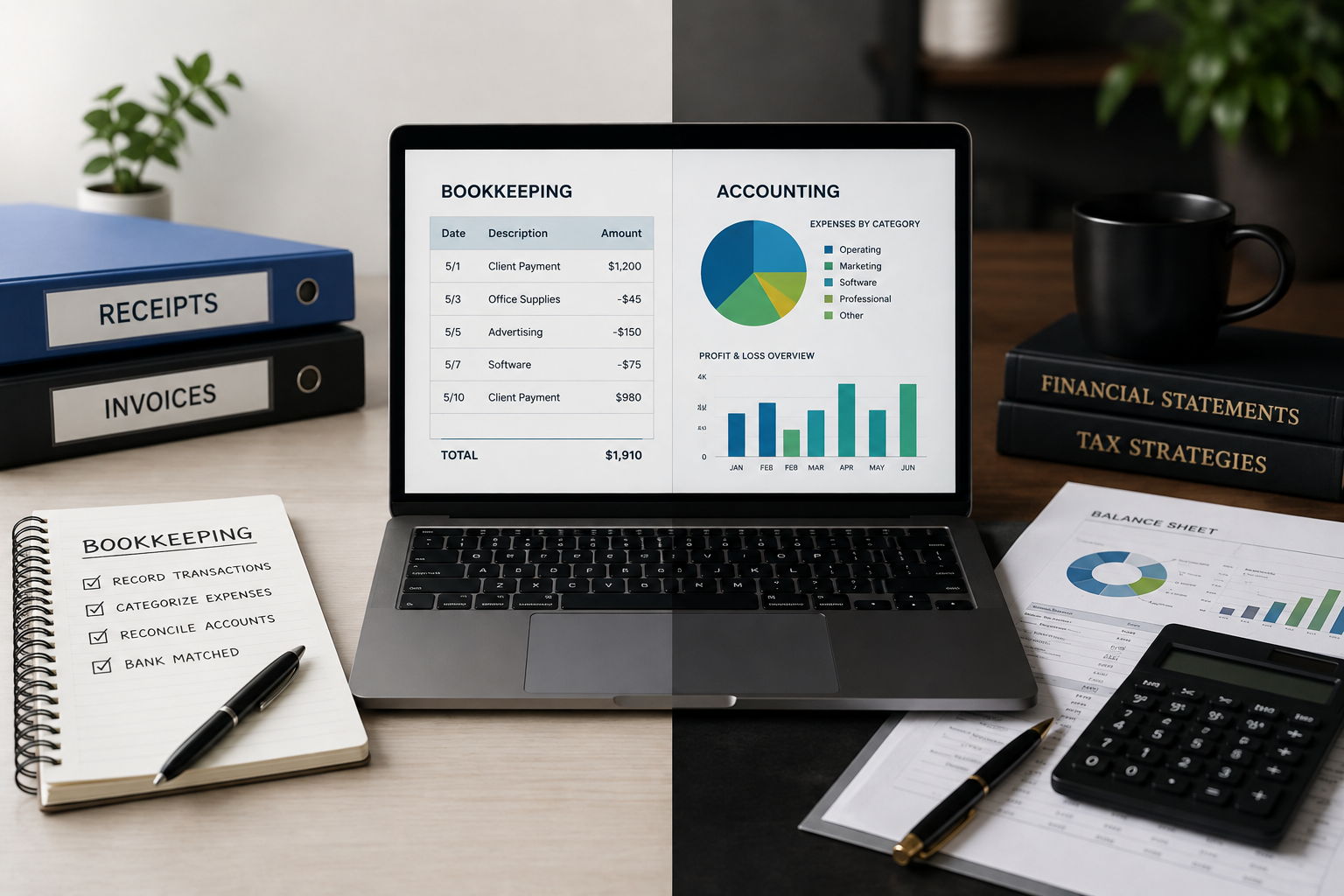
“Bookkeeping” and “accounting” are often used interchangeably.
They are closely related, but they are not exactly the same thing.
And once you add tax preparation and tax planning into the conversation, it can become even harder for a business owner to know what kind of help they actually need.
The easiest way to think about it is that each service answers a different question.
Bookkeeping tells us what happened.
Accounting helps us understand what happened.
Tax preparation reports what happened.
Tax planning helps us decide what to do next.
A business may need one of these services—or all four.
What Is Bookkeeping?
Bookkeeping focuses on maintaining the underlying financial records of the business.
That generally includes activities such as:
Recording and categorizing transactions
Reconciling bank accounts
Reconciling credit cards
Maintaining accounts receivable and payable
Recording loans and fixed assets
Reconciling payroll
Maintaining the general ledger
Preparing financial statements
The objective is to create an accurate record of the financial activity of the business.
Without reliable bookkeeping, everything built on top of those records becomes more difficult.
What Is Accounting?
Accounting takes the information generated through bookkeeping and uses it to understand the financial position and performance of the business.
That may involve reviewing financial statements, correcting accounting issues, analyzing trends, or helping a business owner understand what the numbers mean.
For example, your bookkeeping may show that the business earned $500,000 of revenue.
Accounting starts asking additional questions.
How profitable was that revenue?
How have margins changed?
Why did payroll increase?
How much does the business owe?
Is cash keeping pace with profitability?
Are certain expenses being recorded correctly?
In other words, bookkeeping creates the financial information. Accounting helps turn that information into something useful.
Where Does Tax Preparation Fit In?
Tax preparation is another related—but separate—function.
A tax return takes the financial activity from the year and reports it according to federal and state tax rules.
For a business, that may mean preparing a:
Schedule C
Form 1065 partnership return
Form 1120-S S corporation return
Form 1120 corporate return
The accounting records are often the starting point for that process.
If the books are accurate and reconciled, tax preparation is generally much more straightforward.
If they aren't, someone may first have to determine what actually happened during the year.
That is why poor bookkeeping frequently turns into expensive year-end cleanup.
What About Tax Planning?
Tax planning is forward-looking.
Instead of asking:
“How do we report what happened last year?”
tax planning asks:
“What can we do before the year ends?”
That distinction is important.
Once December 31 has passed, many planning opportunities may no longer be available.
Current bookkeeping can provide the financial information needed to evaluate questions such as:
How much should the business owner pay in estimated taxes?
Should equipment be purchased this year or next?
Is the business owner's compensation reasonable?
Does an entity change make sense?
Should the business establish or contribute more to a retirement plan?
How will a large transaction affect taxable income?
Is the business generating more or less profit than expected?
Tax planning becomes much more useful when it is based on current financial information rather than estimates or last year's numbers.
So Which Service Does Your Business Need?
It depends on where the problem is.
You may need bookkeeping if:
Your transactions aren't regularly categorized or reconciled.
You don't have reliable monthly financial statements.
Your books are several months—or years—behind.
You aren't confident that your QuickBooks records are accurate.
You may need accounting support if:
Your books are maintained, but you don't understand what the financial statements are telling you.
Your balance sheet contains old or unusual balances.
You need help correcting accounting issues.
You want more useful financial reporting.
You may need tax preparation if:
You need federal or state income tax returns prepared for yourself or your business.
You may need tax planning if:
You want to make tax decisions before year-end rather than simply finding out what you owe when the return is prepared.
For many established small businesses, the answer is not choosing one service.
It is connecting them.
Why Connecting Bookkeeping and Tax Can Matter
Imagine a business owner who uses one provider for bookkeeping and another for taxes.
The bookkeeper maintains the accounting records throughout the year.
Then, after the year ends, those records are sent to the tax preparer.
That arrangement can work perfectly well.
But it can also create a gap.
The person thinking about taxes may not see the financial information until after the year is over.
When bookkeeping, accounting, and tax planning are coordinated, current financial information can be used throughout the year.
That makes it easier to spot unusual activity, estimate taxable income, identify planning opportunities, and prepare for upcoming tax obligations.
The books become more than a historical record.
They become part of the planning process.
Think of It as a Financial System
Instead of thinking about bookkeeping, accounting, and taxes as completely separate services, it can be helpful to think of them as parts of the same financial system.
Bookkeeping creates accurate information.
Accounting makes that information understandable.
Tax preparation reports the results.
Tax planning uses the information to help make better decisions going forward.
When those pieces work together, business owners can spend less time trying to figure out what happened and more time deciding what to do next.
Looking for Bookkeeping and Tax Support?
Sharp Tax & Accounting provides virtual bookkeeping, accounting, tax preparation, and tax planning services designed to work together throughout the year.