What Does a Bookkeeper Actually Do for a Small Business?
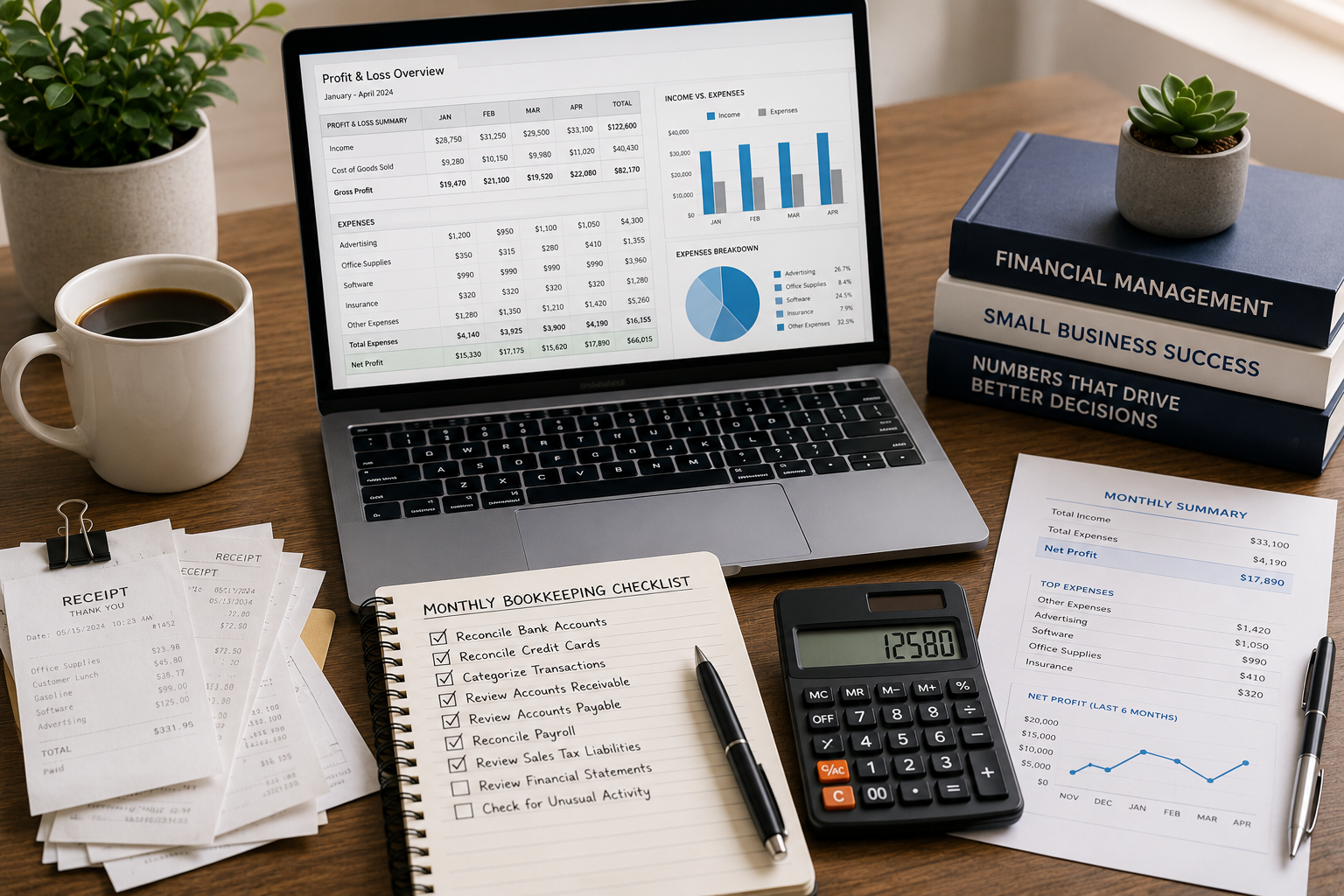
Running a business creates a surprising amount of financial activity.
Money comes in from customers. Bills get paid. Credit cards are used. Loans are taken out and repaid. Owners put money into the business or take money out. Payroll runs. Sales tax may be collected. Equipment gets purchased.
Every one of those transactions eventually has to end up in the right place in your accounting records.
That is where bookkeeping comes in.
At its core, bookkeeping is the process of keeping your business's financial records accurate, organized, and up to date. But good bookkeeping should do more than simply record transactions.
It should help you understand what is happening in your business.
What Does a Bookkeeper Do?
The exact responsibilities can vary depending on the business, but ongoing bookkeeping commonly includes several important functions.
Categorizing Transactions
Most businesses have hundreds or even thousands of transactions throughout the year.
Each transaction needs to be properly recorded and categorized.
For example, a payment might represent:
Advertising
Office supplies
Rent
Insurance
Professional fees
Equipment
Loan payments
Owner distributions
Cost of goods sold
Correct categorization matters because your financial statements—and eventually your tax return—depend on the underlying accounting records being accurate.
Simply having every bank transaction downloaded into QuickBooks does not necessarily mean your books are correct.
Reconciling Bank and Credit Card Accounts
Reconciliation compares the transactions recorded in your accounting system with the activity shown on your bank or credit card statements.
The goal is to make sure the two agree.
Reconciliations can help identify:
Missing transactions
Duplicate transactions
Incorrect amounts
Transactions posted to the wrong account
Checks that have not cleared
Bank or credit card activity that was never recorded
Regular reconciliation is one of the most important controls for maintaining reliable books.
Maintaining the Balance Sheet
Business owners often focus primarily on the profit and loss statement.
But bookkeeping also involves maintaining the balance sheet.
Your balance sheet tracks items such as:
Cash
Accounts receivable
Fixed assets
Credit cards
Loans
Accounts payable
Owner contributions
Owner distributions
Equity
These accounts can easily become inaccurate if transactions are simply categorized based on what appears in the bank feed.
For example, a loan payment usually isn't entirely an expense. Part may reduce the loan balance while another part represents interest expense.
Proper bookkeeping accounts for those differences.
Preparing Financial Statements
Once the books are accurate, they can be used to produce financial statements.
Two of the most common are the profit and loss statement and the balance sheet.
The profit and loss statement helps answer questions such as:
How much revenue did the business generate?
What were its major expenses?
Is the business profitable?
Are expenses increasing?
How does this month compare with previous months or years?
The balance sheet provides a snapshot of what the business owns, what it owes, and its equity at a particular point in time.
These reports are much more useful when the underlying bookkeeping is maintained throughout the year.
Managing Accounts Receivable and Accounts Payable
Depending on the business and the scope of the bookkeeping engagement, a bookkeeper may also assist with accounts receivable and accounts payable.
Accounts receivable tracks amounts customers owe the business.
Accounts payable tracks amounts the business owes vendors and other parties.
Keeping these records current can help a business owner understand not only how much revenue has been earned, but also how much cash is actually expected to come in or go out.
Reconciling Payroll and Sales Tax
Payroll and sales tax can create additional accounting complexity.
Payroll transactions may involve wages, payroll taxes, employee withholdings, benefits, and payroll liabilities.
Likewise, sales tax collected from customers generally isn't revenue. It is typically a liability owed to the appropriate taxing authority.
Good bookkeeping helps ensure these amounts are properly reflected in the accounting records and can make it easier to identify discrepancies before they become larger problems.
Keeping the Books Ready for Tax Season
One of the biggest benefits of consistent bookkeeping is that tax preparation becomes much easier.
If the books have been reconciled and reviewed throughout the year, your tax preparer should not have to reconstruct an entire year's worth of activity before preparing the return.
Clean books can also make it easier to identify potential tax issues before year-end.
For example, current financial information may help with:
Estimated tax calculations
Retirement plan decisions
Equipment purchases
Entity-level tax planning
Reasonable compensation analysis
Cash-flow planning
That is one reason bookkeeping and tax planning work particularly well together.
Bookkeeping Is More Than Data Entry
Modern accounting software can automate a significant amount of bookkeeping.
Bank transactions can automatically download. Rules can suggest categories. Receipts can be uploaded electronically. Invoices can be generated automatically.
But automation does not eliminate the need for accounting judgment.
A transaction can be downloaded perfectly and still be categorized incorrectly.
The real value of bookkeeping isn't simply getting transactions into accounting software.
It is making sure the financial information coming out of the system is reliable.
The Goal: Know Where Your Business Stands
Your accounting records shouldn't be something you look at for the first time when your tax return is due.
Good bookkeeping gives you a clearer picture of your business throughout the year.
You should be able to understand how the business is performing, identify problems earlier, plan for taxes, and make decisions using current financial information.
That is ultimately what bookkeeping should provide: clarity about where your business stands.
Need Help Keeping Your Books Current?
Sharp Tax & Accounting provides virtual bookkeeping services designed to keep your financial records accurate, organized, and ready for both business decisions and tax planning.