Restricted Stock Units and Taxes: What Happens When Your RSUs Vest?
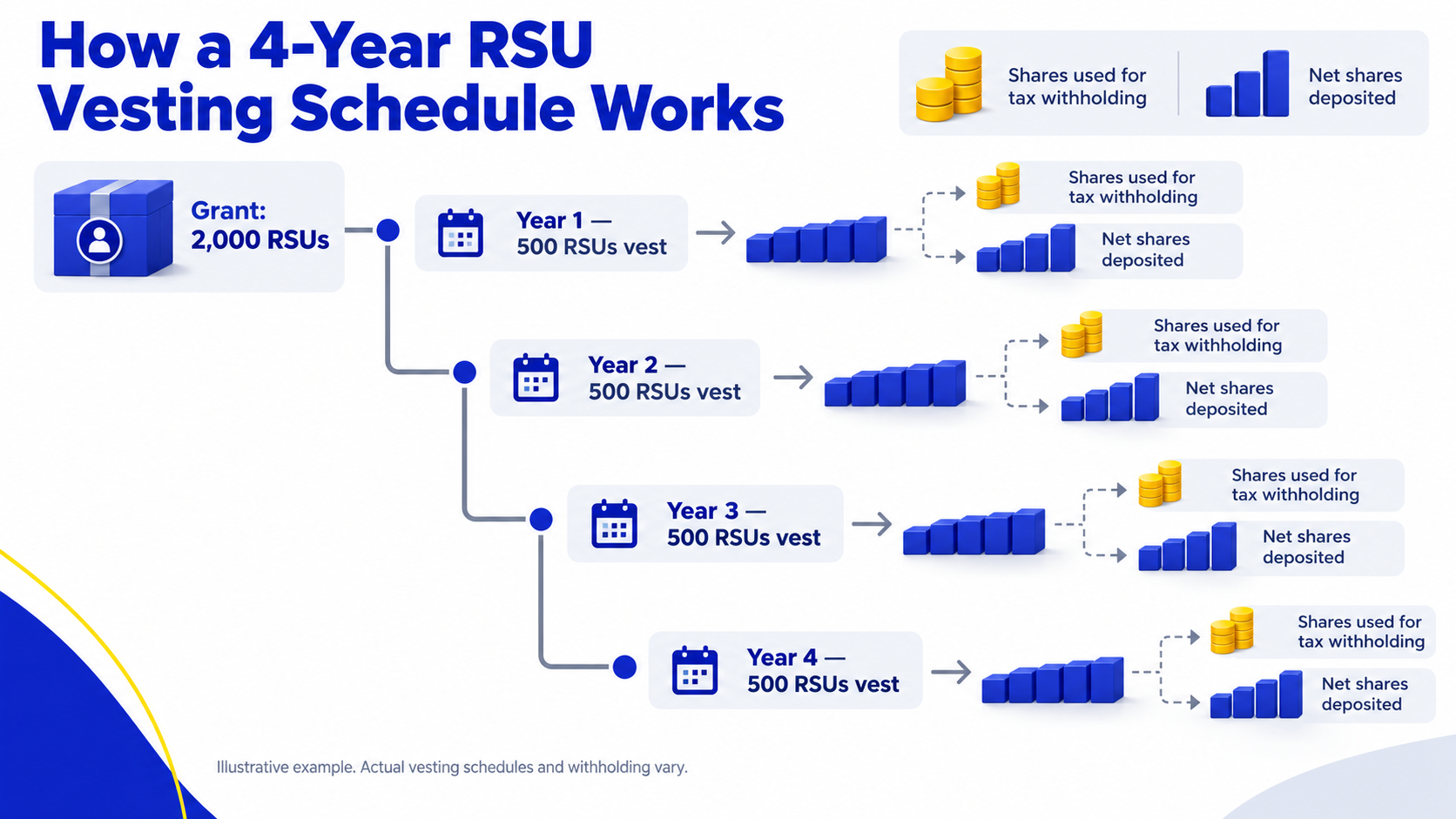
Your employer gave you restricted stock units, commonly called RSUs.
That sounds great until the shares vest and your paycheck suddenly shows thousands of dollars in additional income.
Then you sell the stock and receive a Form 1099-B that appears to report the income all over again.
Are you being taxed twice?
Usually, no. But RSUs can create two separate tax events, and your tax return needs to connect them correctly.
What Is a Restricted Stock Unit?
An RSU is a promise from your employer to give you company stock, or sometimes the cash value of that stock, after certain requirements are satisfied.
Those requirements are usually based on:
Remaining employed for a specified period
Reaching a performance target
Completing a company liquidity event
Meeting a combination of service and performance conditions
Receiving an RSU grant generally does not create immediate taxable income because you do not yet own the shares.
The important tax event normally occurs when the RSUs vest and the shares are delivered to you. Most plans deliver the shares immediately upon vesting, although some plans use a later settlement date.
Here is the basic RSU timeline:
| Event | What Happens | Typical Tax Result |
|---|---|---|
| RSUs are granted | Your employer promises you future shares | Generally no immediate tax |
| Shares are delivered | You receive company stock | Value is generally taxable as wages |
| Shares are sold | You sell the stock you received | Additional gain or loss is reported |
Your stock plan documents should identify the grant date, vesting date, and settlement or delivery date.
When Are RSUs Taxed?
When vested RSUs are settled in shares, the fair market value of those shares is generally treated as wage income.
Example: RSUs Vest
Suppose 100 RSUs are delivered when the company’s stock is worth $50 per share:
| RSU Vesting Calculation | Amount |
|---|---|
| Shares delivered | 100 |
| Value per share | $50 |
| Taxable W-2 compensation | $5,000 |
That $5,000 is generally included in your Form W-2 wages. It is also ordinarily subject to:
Federal income tax withholding
Social Security tax
Medicare tax
State and local income tax, when applicable
You owe tax based on the value of the shares when they are delivered, not the value of the shares when the RSUs were originally granted.
This can create a painful result if the stock price drops after vesting. You may still have $5,000 of wage income even if the shares are worth substantially less by the time you sell them.
How Does RSU Tax Withholding Work?
Employers generally satisfy the tax withholding requirement in one of three ways:
| Withholding Method | What Happens |
|---|---|
| Share withholding | Your employer keeps some of the vested shares to cover taxes |
| Sell to cover | A brokerage firm sells enough shares to cover the required withholding |
| Cash withholding | Taxes are taken from your paycheck or paid separately in cash |
Example: Shares Withheld for Taxes
Assume 100 shares vest at $50 per share, creating $5,000 of wage income. Your employer keeps 25 shares to cover payroll taxes.
| What Happened | Shares | Value |
|---|---|---|
| Total shares vested | 100 | $5,000 |
| Shares withheld for taxes | 25 | $1,250 |
| Shares deposited into your account | 75 | $3,750 |
You still had $5,000 of taxable wage income. The 25 withheld shares represent tax payments. They do not reduce the amount of compensation you earned.
Most importantly, withholding is only a prepayment. It is not necessarily your final tax liability.
RSU income is often treated as supplemental wages for federal withholding purposes. The rate used by the employer may be lower than your actual marginal tax rate.
That means you could still owe additional tax even though some of your shares were withheld.
Large RSU awards can also affect:
Your marginal federal tax bracket
Estimated tax requirements
Additional Medicare Tax
State estimated tax requirements
Eligibility for income-based deductions and credits
Net Investment Income Tax on later investment income
Do not assume that “taxes were already taken out” means enough was withheld.
What Happens When You Sell the Shares?
Vesting and selling are two separate tax events.
The value of the shares when they are delivered is generally reported as wage income. Any subsequent change in value generally creates a capital gain or loss when you sell the shares.
Example: You Sell the Remaining Shares
Continuing the previous example, assume your employer withheld 25 shares and deposited 75 shares into your brokerage account.
You later sell the 75 shares for $60 each.
| Capital-Gain Calculation | Amount |
|---|---|
| Shares sold | 75 |
| Sale price per share | $60 |
| Cost basis per share | $50 |
| Gain per share | $10 |
| Total capital gain | $750 |
The original $50-per-share value was generally already included in your W-2 wages. Only the subsequent $10-per-share increase is generally a capital gain.
If you instead sold the shares for $40 each, the calculation would look like this:
| Capital-Loss Calculation | Amount |
|---|---|
| Shares sold | 75 |
| Sale price per share | $40 |
| Cost basis per share | $50 |
| Loss per share | ($10) |
| Total capital loss | ($750) |
The holding period normally begins when you acquire the shares.
A sale after holding the shares for more than one year may qualify for long-term capital-gain treatment. A sale after one year or less generally produces a short-term capital gain or loss.
Are RSUs Taxed Twice?
RSUs may look like they are being taxed twice because the shares can appear on both your Form W-2 and Form 1099-B.
However, those forms report different events:
| Tax Event | What Is Taxed | Where It Is Reported |
|---|---|---|
| Shares are delivered | Value of the shares when received | Form W-2 |
| Shares are later sold | Change in value after receipt | Form 1099-B and Form 8949 |
The most common problem is an incorrect or incomplete cost basis on Form 1099-B.
Suppose you sell 75 shares for $60 each. Your total sales proceeds are $4,500.
If the brokerage reports a zero basis, your tax software may calculate the following:
| Incorrect Calculation | Amount |
|---|---|
| Sales proceeds | $4,500 |
| Basis reported by brokerage | $0 |
| Incorrect taxable gain | $4,500 |
But if $50 per share was already included in your W-2 wages, the calculation should generally be:
| Corrected Calculation | Amount |
|---|---|
| Sales proceeds | $4,500 |
| Correct cost basis | $3,750 |
| Actual capital gain | $750 |
Without the basis adjustment, you could effectively pay tax twice on the same $3,750 of income.
Before filing your return, compare:
Your Form W-2
Your Form 1099-B
Your year-end brokerage statement
Your RSU vesting confirmations
The fair market value of the shares when delivered
The number of shares withheld or sold for taxes
Your capital-gain calculation may require an adjustment on Form 8949 if the brokerage statement does not reflect the income previously included in your wages.
What If You Worked in More Than One State?
RSUs become more complicated when you move or work in multiple states between the grant date and the vesting date.
More than one state may claim the right to tax part of the RSU income based on:
Where you worked during the vesting period
Where you lived when the RSUs were granted
Where you lived when the shares were delivered
The number of workdays spent in each state
Each state’s income-sourcing rules
Example: You Move Before the RSUs Vest
Assume you received RSUs while working in California. You later moved to Minnesota, but the RSUs did not vest until after the move.
| State | Possible Tax Treatment |
|---|---|
| California | May tax the portion connected to services performed in California |
| Minnesota | May tax the income received while you were a Minnesota resident |
| Resident-state credit | May help prevent the same income from being fully taxed twice |
Moving before the vesting date does not necessarily prevent your former state from taxing part of the income.
You may need to file a nonresident or part-year resident return and claim a credit for taxes paid to another state when available.
Keep your grant documents, vesting schedules, employment records, moving dates, and work-location information. Reconstructing those records several years later can be difficult.
Can You Make an 83(b) Election?
An 83(b) election is generally not available for a traditional RSU grant.
That election applies when property has already been transferred to you but remains subject to a substantial risk of forfeiture. With an RSU, you generally receive only a promise of future shares at the time of the grant. You do not receive the shares themselves.
RSUs and restricted stock awards may sound similar, but they are not the same:
| Equity Award | What You Receive at Grant | 83(b) Election Generally Available? |
|---|---|---|
| Restricted stock units | A promise of future shares | No |
| Restricted stock award | Actual restricted shares | Potentially |
An 83(b) election has a strict deadline and can create significant tax consequences. If you receive actual restricted shares, review the award promptly rather than waiting until tax-return season.
The Bottom Line
RSU taxation generally involves two important events:
| Event | General Tax Treatment |
|---|---|
| Shares are delivered | Fair market value is generally taxable as wage income |
| Shares are sold | The subsequent change in value creates a capital gain or loss |
The biggest mistakes usually happen when taxpayers:
Assume the employer withheld enough tax
Use an incorrect cost basis
Report the full sale proceeds as capital gain
Forget about multistate tax exposure
Confuse RSUs with restricted stock awards
Fail to plan for a large vesting event
RSUs can be valuable compensation. They can also create a surprisingly large tax bill when the income and withholding are not reviewed before year-end.
Need Help?
Sharp Tax & Accounting helps individuals understand the tax consequences of restricted stock units, review tax withholding, correct stock basis, plan for upcoming vesting events, and address multistate tax issues.
If you received RSUs, sold company stock, or moved between states during the vesting period, schedule a consultation before filing your tax return.
This article provides general information and does not constitute tax or legal advice. The tax treatment of equity compensation depends on the terms of the award, the employer’s plan, the taxpayer’s residence, and other individual circumstances.