Sales Tax on Digital Products: What Content Creators Need to Know
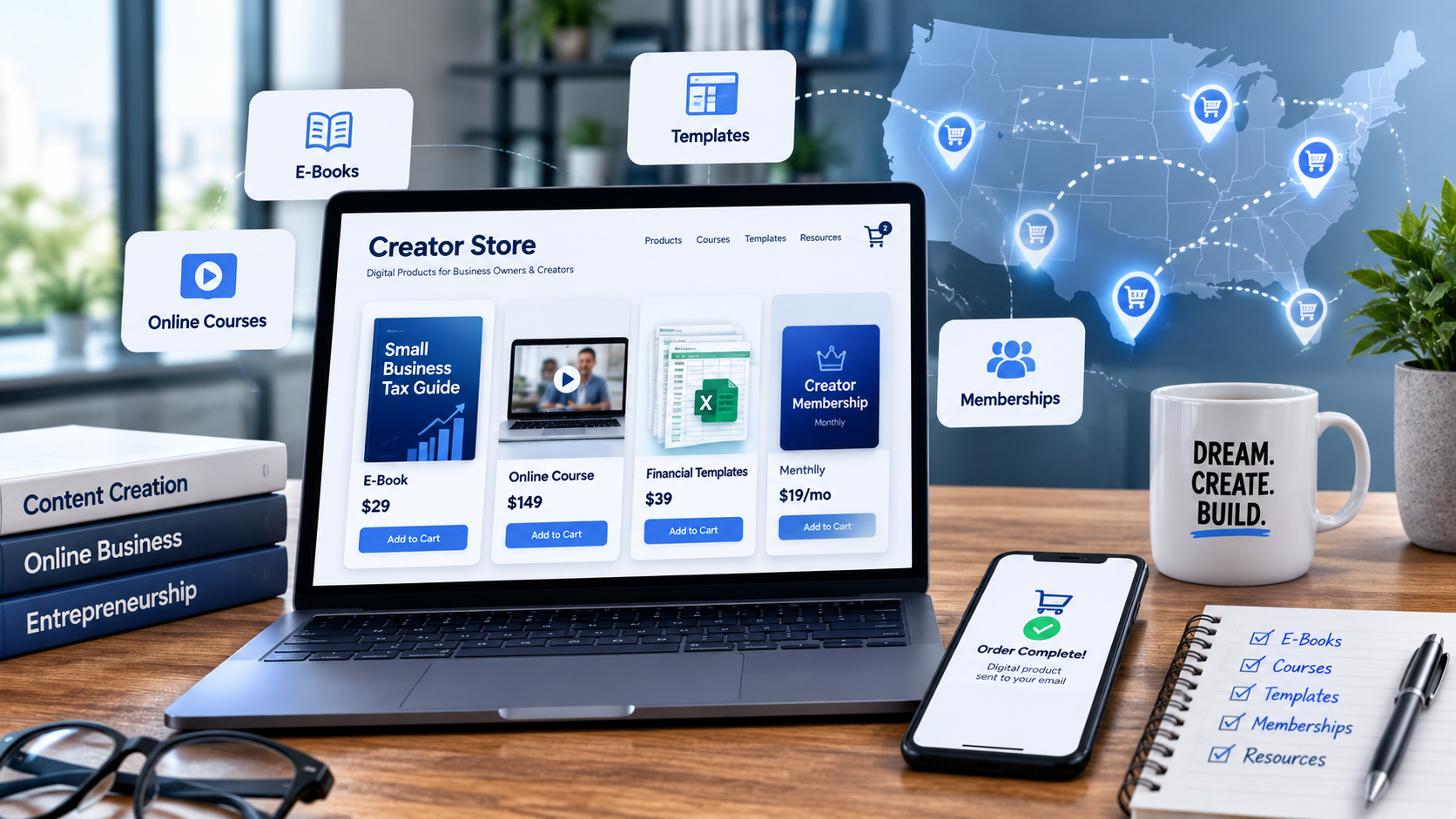
Selling a digital product can feel simple.
Create an e-book, template, online course, preset, membership, or downloadable guide, put it online, and start making sales.
But there is another question creators sometimes overlook:
Do you need to charge sales tax?
The answer depends on what you are selling, where your customer is located, how the product is delivered, and the sales tax rules in that state.
Unlike federal income tax, there is no single nationwide rule for taxing digital products. A product that is taxable when sold to a customer in one state may be exempt when sold to a customer in another.
For creators selling digital products across the country, that can make sales tax considerably more complicated than simply adding a tax rate at checkout.
What Is a Digital Product?
“Digital product” is a broad term, and states do not necessarily define it the same way.
For content creators, digital products might include:
E-books and digital guides
Downloadable templates
Lightroom presets
Stock photos
Digital artwork
Music and audio files
Downloadable videos
Online courses
Paid memberships
Subscription content
Worksheets and printables
Digital planners
Design files
Software or apps
The important point is that being delivered electronically does not automatically make something exempt from sales tax.
States determine which products and services are taxable under their own laws.
Digital Products Are Not Taxed the Same in Every State
This is where things get complicated.
Some states tax certain digital products while others exempt them. States may also distinguish between downloaded products, streaming access, subscriptions, software, electronically delivered services, and other types of digital content.
Even products that appear similar can receive different treatment.
Minnesota is a good example.
Minnesota taxes certain digital products, including digital audio works, digital audiovisual works, digital books, online games, and certain digital codes. At the same time, electronically delivered products such as digital photos, drawings, logos, designs, charts, and graphs may be nontaxable.
That means a creator selling an e-book and a creator selling downloadable photography could potentially have different Minnesota sales tax results even though both products are delivered electronically.
The takeaway is simple:
“It’s digital” does not mean “it’s tax-free.”
You have to determine what you are actually selling and then look at how the applicable state treats that product.
Example: Selling an E-Book
Suppose a creator writes a $25 downloadable guide and sells it directly through their website.
The creator lives in Minnesota, but customers purchase the guide from around the country.
The sales tax question is not limited to where the creator lives.
You first need to determine whether the product is taxable in the state where the sale is sourced. For digital products, customer location information can become particularly important.
Minnesota, for example, generally sources a digital product to the purchaser’s address the seller has on file.
But determining whether the product is taxable is only part of the analysis.
You also need to determine whether your business has enough connection with that state to be required to collect its tax.
That brings us to nexus.
Selling Across State Lines? Nexus Matters Too
Selling a digital product to a customer in another state does not automatically mean you need to register for sales tax there.
The question is whether your business has sales tax nexus with that state.
Nexus can arise through physical activity, such as employees or inventory, or through economic activity after your sales exceed a state’s applicable threshold.
Rather than repeat the nexus rules here, we have a separate guide explaining how nexus works, economic nexus thresholds, physical presence, and when businesses may need to register in another state:
Read: State Tax Nexus: When Does Your Business Have to File in Another State?
For creators, the important point is that a growing national audience can eventually create state tax obligations even when the business itself is completely virtual.
Online Courses Can Be More Complicated Than They Look
Online courses present another issue because a “course” may actually contain several different products or services.
For example, a creator might sell a course that includes:
Prerecorded video lessons
Downloadable PDFs
Templates
Live instruction
Group coaching
Private community access
Audio recordings
Membership benefits
Those components may not necessarily receive the same sales tax treatment.
Even within Minnesota, the treatment of electronically delivered educational content can depend on exactly what is being provided. Minnesota, for example, specifically addresses webinars and online classes in its digital-product guidance.
That means simply calling something an “online course” does not necessarily answer the sales tax question.
The substance of the product matters.
Be Careful When You Bundle Products Together
Creators frequently sell bundles.
For example:
Creator Business Bundle: $99
E-book
Video course
Templates
Private community access
One live group call
From a marketing perspective, bundling everything together may make perfect sense.
From a sales tax perspective, it can create another question:
What happens if some of the items are taxable and others are not?
Again, the answer depends on the state.
Minnesota, for example, has specific rules for bundled transactions. A transaction containing taxable and nontaxable items sold for one price may be taxable unless an exception applies. Minnesota also provides a de minimis rule when the taxable portion of certain bundled transactions is 10% or less of the total.
How products are packaged and priced can therefore matter.
This is one reason sales tax is worth considering before launching a complicated product bundle instead of after thousands of customers have already purchased it.
What About Sales Through Multiple Platforms?
Creators often have more complicated sales channels than they realize.
You might sell:
Digital downloads through Etsy
Courses through a course platform
Merchandise through Shopify
Paid subscriptions through Substack
Products directly through your own website
Products or services through other third-party platforms
That matters because your sales tax responsibilities may differ depending on the channel.
A marketplace may be legally required to collect and remit sales tax on certain transactions under a state’s marketplace facilitator law.
That does not mean every website or platform that processes a payment is doing the same thing.
Do not assume a platform is handling sales tax simply because it collects money from your customers.
Substack is a good example.
Substack integrates with Stripe Tax, but creators have to set it up. If a creator exceeds a tax threshold in a jurisdiction, the creator generally needs to register with the applicable tax authority and add that registration to Stripe Tax.
Substack explains that Stripe Tax only collects sales tax through Substack in locations where the creator has added a tax registration.
So imagine a creator has enough sales in a state to create a registration requirement but never registers there.
Simply accepting paid subscriptions through Substack does not mean Substack has automatically been collecting the required sales tax.
That is an important distinction.
A creator should know whether a platform is:
Acting as a marketplace facilitator and taking responsibility for collection
Providing software that can calculate and collect tax after the creator configures it
Or simply processing the payment
Those are not the same thing.
The question to ask is:
Who is legally responsible for collecting and remitting the sales tax on this transaction—the platform or me?
Sales Across Platforms May Need to Be Combined
Using several platforms can also make monitoring state activity more difficult.
Imagine you sell:
$40,000 through your own website
$35,000 through a course platform
$20,000 through a marketplace
$15,000 through another sales channel
Looking at each platform independently might make your sales into a state appear relatively small.
Looking at the business as a whole could tell a different story.
That is why creators should maintain records that allow them to determine total sales by state across their sales channels.
And although a marketplace may be collecting tax on certain transactions, that does not necessarily mean those marketplace sales can simply be ignored when analyzing whether you have crossed a state’s nexus threshold.
The rules vary by state.
If you need a deeper explanation of how those thresholds work, see our guide:
State Tax Nexus: When Does Your Business Have to File in Another State?
Customer Location Becomes Important
When your customers are spread across the country, knowing where your sales are going becomes increasingly important.
For digital products, states have sourcing rules that determine where a transaction is treated as occurring.
Depending on the circumstances, that may involve information such as:
Customer address
Billing address
Delivery information
Business address
Information associated with the payment method
Minnesota generally sources digital products to the purchaser’s address that the seller has on file.
That creates a practical problem if your checkout system does not collect enough customer information.
A creator may know that they made $200,000 selling a digital product but have poor records showing where those customers were located.
That can make a later sales tax analysis much more difficult.
What Should Creators Selling Digital Products Be Tracking?
You do not necessarily need to perform a fifty-state sales tax study when you make your first $20 digital sale.
But as the business grows, you should have enough information to identify when sales tax may become an issue.
Creators selling digital products should be able to determine:
What products or services they are selling
How those products are delivered
Where their customers are located
Total sales by state
Sales occurring through marketplaces
Sales occurring directly or through other platforms
Whether a platform is actually collecting sales tax
Where the business is already registered
Whether sales are approaching nexus thresholds in other states
The larger and more geographically dispersed your audience becomes, the more important that information becomes.
The Bottom Line
Whether a creator needs to collect sales tax can depend on the product being sold, where the customer is located, how the state taxes that product, whether the creator has nexus with the state, and how the sale is being made.
And do not assume that using a platform means the platform is taking care of sales tax for you.
Some marketplaces may collect and remit tax. Other platforms may simply give you the tools to collect it yourself.
For creators building businesses with customers across the country, understanding that distinction can prevent a growing sales tax problem from hiding behind a successful product launch.
Need Help?
Sharp Tax & Accounting helps content creators navigate the tax issues that can come with turning an online audience into a business.
If you sell digital products, courses, paid subscriptions, memberships, merchandise, or other products to customers across multiple states, we can help evaluate your sales tax exposure, determine where registration may be required, and help manage ongoing multistate sales tax compliance.
This article provides general tax information and is not intended as individualized tax, legal, or financial advice. Tax treatment depends on the specific facts and circumstances of each situation.