State Tax Nexus: When Does Your Business Have to File in Another State?
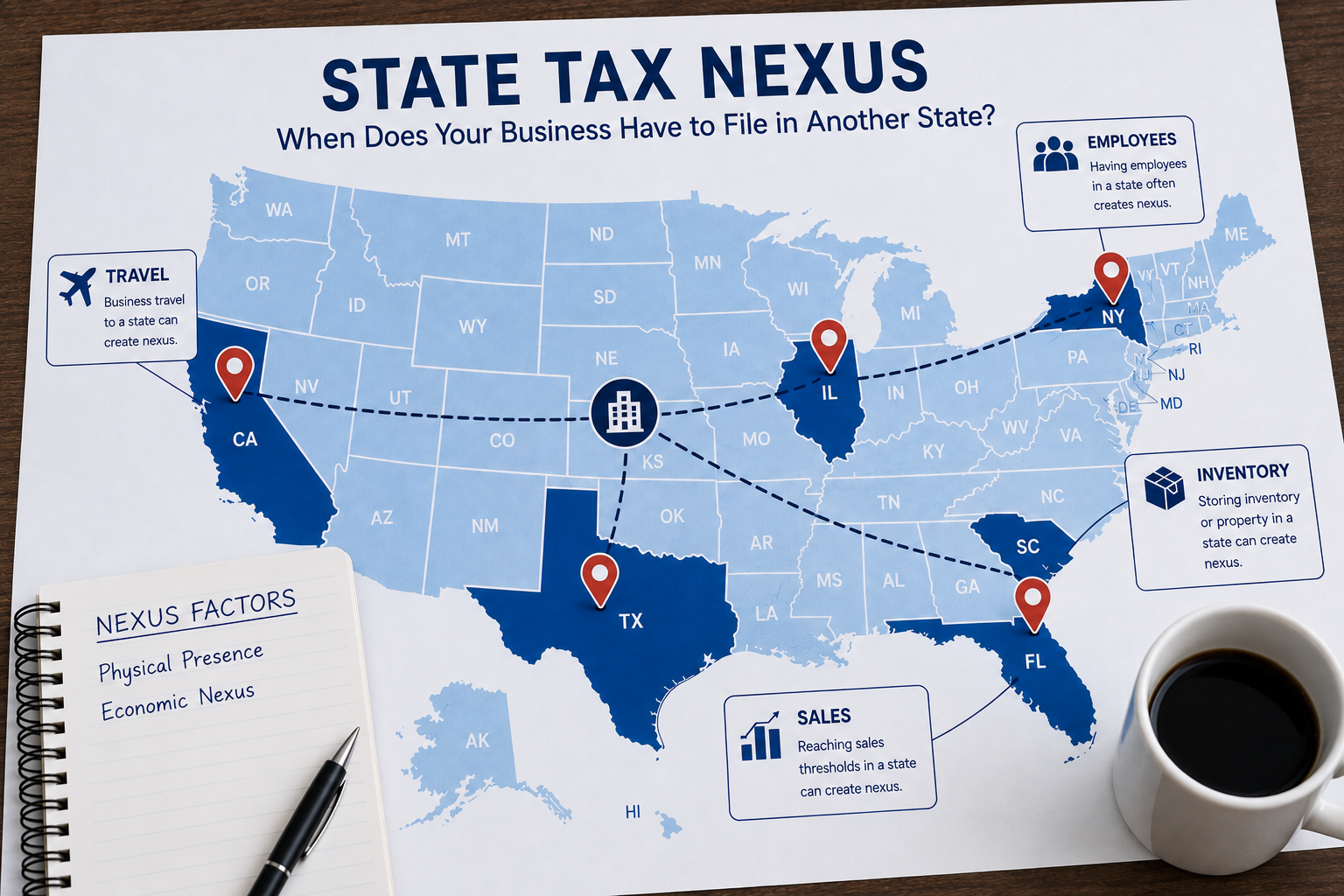
Doing business in more than one state can create tax obligations faster than many business owners realize.
You may not have an office, storefront, warehouse, or employee in another state. But your customers or economic activity there may still be enough to create a filing obligation.
That connection between a business and a state is generally called nexus.
Understanding where your business has nexus is one of the first steps in determining where you may need to register, file tax returns, collect sales tax, or pay state taxes.
What Is State Tax Nexus?
Nexus is generally the connection between a business and a state that allows the state to impose a tax or filing requirement on that business.
The important part is that nexus is not one universal test.
A business might have nexus for:
State income tax
Franchise tax
Gross receipts tax
Sales and use tax
Payroll withholding
Other state or local taxes
And the rules can differ significantly from one state to another.
That means determining nexus usually requires asking two questions:
What activities does the business have in the state?
and
What type of tax are we analyzing?
Physical Presence Can Create Nexus
Physical presence is one way a business can establish nexus with a state.
Examples may include:
An office
A store
A warehouse
Inventory
Equipment
Employees
Salespeople
Employees working remotely from another state
Employee travel into another state
Independent contractors working remotely from another state
Independent contractor travel into another state
For example, a business headquartered in Minnesota that hires an employee who works permanently from another state may create income tax, payroll, or other state tax obligations there.
The same issue can arise when a business stores inventory in a third-party warehouse or fulfillment center outside its home state.
But physical presence is not required for every type of state tax nexus.
Economic Activity Can Create Nexus
A business does not always need employees, property, or an office in a state to establish nexus.
Many states use economic or factor-presence standards that look at the amount of business activity a company has in the state.
Depending on the tax and the state, nexus may be created by factors such as:
Sales into the state
Property in the state
Payroll in the state
Other business activity or receipts
This can apply to several different types of state taxes, including:
Sales and use tax
Corporate income tax
Franchise tax
Gross receipts tax
That means a business with customers across the country may have state filing obligations even when all of its employees and operations are located in one state.
For sales tax, economic nexus became especially prominent after the U.S. Supreme Court’s decision in South Dakota v. Wayfair, which eliminated the physical-presence requirement for sales tax collection.
But economic nexus is not limited to sales tax.
Businesses also need to consider whether their economic activity creates income tax, franchise tax, or gross receipts tax filing obligations in other states.
Different Tax Types Have Different Nexus Rules
One common mistake is treating nexus and sales tax nexus as if they mean the same thing.
They do not.
Nexus generally needs to be evaluated separately for each type of tax.
Sales and Use Tax
Does the business have sufficient connection with the state to require registration and collection of sales tax?
This may arise through physical presence, economic activity, or both.
Income or Franchise Tax
Does the business have sufficient activity in the state to create a filing requirement for income, franchise, or similar business taxes?
This may be based on physical activity, economic activity, or both.
Gross Receipts Taxes
Some states impose taxes based on gross receipts or business activity rather than traditional net income.
These taxes can have their own nexus thresholds and sourcing rules.
A business may therefore have nexus for one type of tax but not another.
Activities That Should Trigger a Nexus Review
You do not necessarily need to perform a nexus study every time something changes in your business.
But certain events should at least raise the question.
Consider reviewing your state tax footprint when your business:
Begins selling into new states
Experiences significant growth in out-of-state sales
Hires an employee in another state
Allows an existing employee to work remotely from another state
Opens an office or other location
Stores inventory outside its home state
Begins using third-party fulfillment services
Sends employees into other states to perform services
Acquires another business
Starts selling a new product or service
Expands through e-commerce
The goal is to identify potential obligations before the business starts receiving notices from states.
Crossing a Nexus Threshold Does Not Always Mean You Owe Tax
Another important distinction:
Having a filing requirement and owing tax are not necessarily the same thing.
A business might establish nexus and become required to file a state return but ultimately owe little or no tax after applying that state’s tax calculation, apportionment rules, deductions, credits, or other provisions.
Similarly, sales tax nexus does not necessarily mean every sale is taxable.
The business still needs to determine whether the products or services it sells are actually subject to tax in that state.
That is why nexus is generally the starting point of a state tax analysis, not the end of it.
What Happens If You Discover Nexus Late?
Sometimes a business reviews its operations and realizes it may have had nexus in another state for several years.
Ignoring the issue usually does not make it disappear.
Potential exposure can include:
Unfiled tax returns
Uncollected sales tax
Back taxes
Interest
Penalties
State notices
Audit exposure
Depending on the circumstances and the state involved, businesses may have options for addressing historical exposure.
One option may be a voluntary disclosure agreement, which can allow an eligible taxpayer to approach a state and resolve prior-period liabilities under that state’s program. See our article “Voluntary Disclosure Agreements: A Smart, Cost-Saving Strategy for Resolving Hidden State Tax Liabilities” for a closer look at how VDAs can work.
Ultimately, the appropriate approach depends heavily on the specific facts, state, tax type, and filing history.
Nexus Should Be Reviewed as Your Business Grows
A nexus analysis is not necessarily something you do once and never revisit.
A company with only local customers today may be selling nationwide a few years from now.
A business may hire remote employees.
An online retailer may add a fulfillment provider.
A consulting company may begin serving customers throughout the country.
As the business changes, its state tax footprint can change with it.
Periodically reviewing where the company has customers, employees, property, inventory, and other business activity can help identify new filing requirements before they become larger compliance problems.
The Bottom Line
State tax nexus answers a basic question:
Does your business have enough connection with a state for that state to impose a tax or filing requirement?
But the answer can depend on:
Where you have employees
Where you own or store property
Where you perform services
Where your customers are located
How much you sell into a state
What type of tax is being considered
And there is rarely one nexus rule that applies everywhere.
For businesses operating across state lines, understanding where nexus exists is an important first step toward determining where to register, what returns to file, and whether historical exposure needs to be addressed.
Need Help Reviewing Your State Tax Nexus?
Sharp Tax & Accounting provides state and local tax consulting for businesses operating across multiple jurisdictions.
We can help evaluate your business activities, identify potential state tax filing obligations, review historical exposure, and develop a practical approach to multi-state tax compliance.
This article provides general tax information and is not intended as individualized tax, legal, or financial advice. Tax treatment depends on the specific facts and circumstances of each situation.